Dental SEO is the work that gets a dental practice found in Google’s unpaid results: the map pack of nearby practices, the list of websites below it and, on more and more searches, the AI Overview above both. Google describes SEO as “helping search engines understand your content, and helping users find your site and make a decision about whether they should visit your site through a search engine” (SEO Starter Guide). For a private practice the aim is narrower: new private patients who find the practice themselves, with no cost per click.
This guide covers what a UK private practice owner needs to know before doing SEO or paying for it: which searches matter, the first three things to check, the GDC’s website rules, NHS pages on a mixed practice, AI Overviews, and how long it all takes. A disclosure first: I sell dental SEO services to UK private practices through Cogrank, my consultancy.
Written by Bogdan Matanie, founder of Cogrank, a Google Ads and SEO consultancy for UK private dental practices. Last updated November 2026.
Where do patients find a practice on Google?
In three places on the same results page, and each one is won differently.
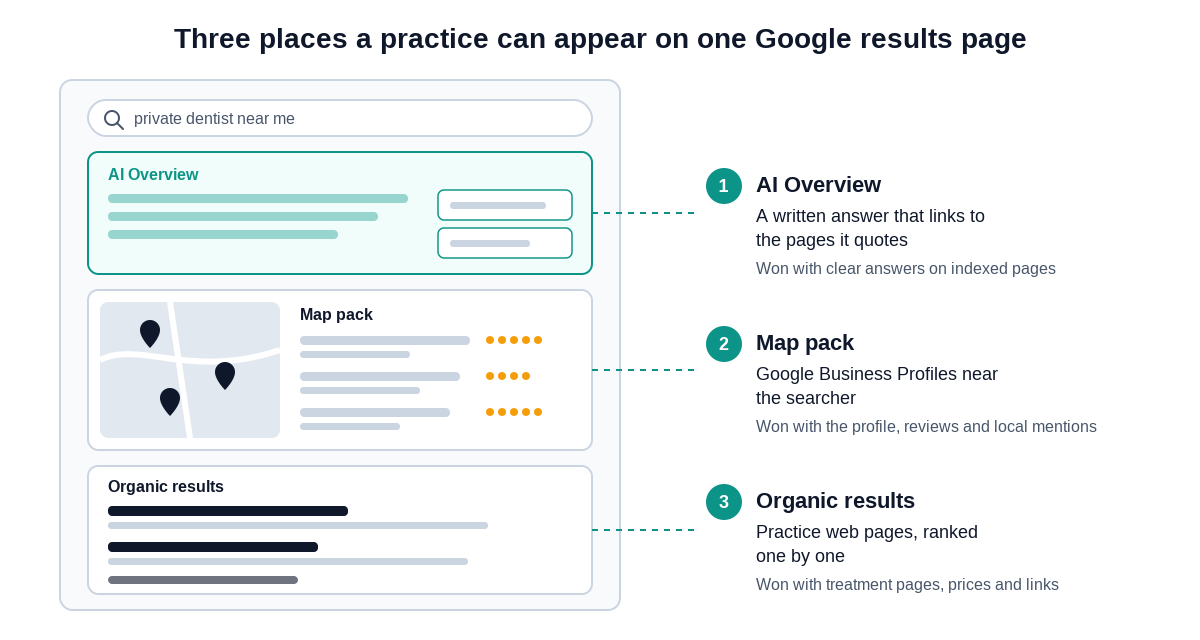
| Place on the page | What Google shows there | What the practice works on |
|---|---|---|
| AI Overview | A written answer with links to the pages it draws on | Clear answers on its own pages, and being indexed |
| Map pack | Google Business Profiles near the searcher | The profile, its reviews and local mentions |
| Organic results | Web pages, ranked one by one | Treatment pages, prices, technical health and links |
Search is where many people start. In the ONS’s July–August 2026 survey, people in England without a dentist who tried to get urgent NHS care most often chose which practice to contact by “using an online search (30.9%)”, ahead of the NHS website (25.5%) (ONS, September 2026). The figure is about urgent NHS care, not private treatment, but it shows how patients go looking.
Which searches bring private patients?
Local searches dwarf everything else, and NHS searches outnumber private ones by about eight to one. These are UK Google Ads search volumes, averaged over September 2025 to August 2026, pulled by Cogrank through DataForSEO on 12 October 2026:
| Search | UK searches a month | What it needs from the practice |
|---|---|---|
| dentist near me | 260,583 | A Business Profile in the map pack |
| invisalign | 95,375 | A treatment page |
| nhs dentist near me | 88,250 | An honest NHS page and NHS website profile |
| teeth whitening | 66,125 | A treatment page |
| nhs dental taking new patients | 13,492 | An honest NHS page and NHS website profile |
| private dentists near me | 10,742 | A Business Profile in the map pack |
| dental implants cost uk | 10,033 | A treatment page with a price |
| dentist check up cost | 2,275 | A price list |
| private dentist cost | 1,047 | A price list |
| private dentist price list | 148 | A price list |
“invisalign” and “teeth whitening” also include people comparing brands and home kits, so not every one of those searches is a patient choosing a practice.
The price searches matter because the rules already require prices online. GDC standard 2.4.2 says “You must give clear information on prices in your practice literature and on your websites - patients should not have to ask for this information” (GDC Standards for the Dental Team, principle 2). The CMA’s guidance for patients makes the same point: “Dentists should give clear information on their prices on their websites” (GOV.UK). A practice that publishes its prices meets the rule and answers the search.
What should a practice check first?
The profile’s category, a priced page for each treatment, and tracking. I start every review of a practice’s website and Business Profile with these three, before any 30-item checklist:
- The Business Profile’s primary category and services. “Dentist” should be the primary category, with every treatment the practice wants enquiries for listed as a service. Google asks owners to “Use as few categories as possible to describe your overall core business from the provided list” (Business Profile guidelines). The local SEO guide for dentists has the full profile checklist.
- A page for each private treatment, with a “from” price and the clinician’s GDC number. One page per treatment gives Google something specific to rank for “dental implants” or “composite bonding”, and the price answers what patients search for. The GDC already accepts ranges for items that vary in cost (standard 2.4.1), and its guidance on advertising requires a website that names a dental professional providing care to show “your GDC registration number”.
- Whether enquiries are tracked at all. Without tracking, nobody can say whether SEO brings patients. In Cogrank’s October 2026 sample of 40 Manchester Business Profile listings for “private dentist”, 14 had tracking parameters on their website link. That is one city, so read it as a pointer, not a national figure.
How do the map pack, the website and reviews fit together?
The website ranks in the organic results, the profile ranks in the map pack, and reviews feed the profile. Google says “Local results are mainly based on relevance, distance, and popularity”, and adds: “There’s no way to request or pay for a better local ranking on Google” (Business Profile Help).
| Map pack factor | Google’s description | What the practice can change |
|---|---|---|
| Relevance | “how well a Business Profile matches what someone is searching for” | Categories, services and a complete profile |
| Distance | “how far each business is from the customer who’s searching” | Nothing, beyond where the practice is |
| Popularity (the page also calls it prominence) | “how many websites link to your business and how many reviews you have” | Reviews over time, links and local mentions |
The profile sends patients to the website, so a weak treatment page loses the enquiry the profile won.
Reviews are where practices take shortcuts. My rule: never pay for reviews, and never reward a patient in any way for leaving one. Google’s prohibited content policy bans offering “incentives – such as payment, discounts, free goods and/or services - in exchange for posting any review”, and the Digital Markets, Competition and Consumers Act 2024 bans commissioning “a consumer review that conceals the fact it has been incentivised” (Schedule 20, paragraph 13). The local SEO guide covers what to do instead: the same request to every patient, at the same point after the visit.
What must a UK practice website show?
The GDC sets a fixed list. Its guidance on advertising says that whoever is responsible for a practice website “must ensure that the following information is displayed”:
| Item | The GDC’s wording |
|---|---|
| Where care is provided | “the name and geographic address at which the dental service is provided” |
| How to get in touch | “contact details of the dental service, including e-mail address and telephone number” |
| The regulator | “the GDC’s address and other contact details, or a link to the GDC website” |
| Complaints | “details of the practice’s complaints procedure”, plus who patients can contact if not satisfied: the NHS body for NHS treatment and the Dental Complaints Service for private treatment |
| Freshness | “the date the website was last updated” |
| Each dental professional named | “your professional qualification and the country from which that qualification is derived” and “your GDC registration number” |
Few practices show all of it: in Cogrank’s audit of 425 practice websites in England, 5 showed every item on this list. Add the prices from standard 2.4.2 and that is the full list. Google doesn’t name any of these items as ranking factors. They belong in an SEO review anyway, because SEO sends patients to these pages, and a page that brings enquiries should also meet the regulator’s rules.
Should NHS and private treatment share one website?
Yes, as long as the NHS page is honest about availability. NHS searches are the bigger ones: “nhs dentist near me” averages 88,250 a month, against 10,742 for “private dentists near me”. For a mixed practice that isn’t taking new NHS patients, I would:
- keep the NHS page live;
- add a clear notice that the practice isn’t accepting new NHS patients at the moment;
- if the site has an enquiry form, ask first whether the enquiry is NHS or private, and when the answer is NHS, close the form with a message that the practice is temporarily not accepting new NHS patients.
The live page keeps the practice visible for NHS searches and lets existing NHS patients find it. The notice and the form save the reception team calls and replies that can’t turn into bookings, and give the patient a straight answer. The closing message can also link to the NHS website’s Find a dentist service, so the patient knows where to look next.
The NHS profile has its own rule. In England, NHS dental contracts require the practice to review its profile on the NHS website “at least once in every period of 90 days” (GDS Contracts Regulations 2005, Schedule 3, paragraph 34A), and the NHS Business Services Authority says each quarter’s confirmation covers “whether the practice is accepting new NHS patients” (NHSBSA). Keep the website and that profile saying the same thing.
What do AI Overviews change for dental SEO?
Less than “AEO” packages suggest, and more than rankings show. Google’s page on AI features and your website says a page has to be indexed and eligible to appear with a snippet, that “There are no additional technical requirements”, and that “specific optimization isn’t required for AI Overviews and AI Mode”. I agree with Google completely. Good SEO leads to AEO, so there’s no need to charge for it as an add-on.
What AI Overviews do change is the click. Cogrank’s own dental SEO pricing guide is cited in the AI Overview for “dental seo pricing”, which quoted its table of monthly price ranges in a rank check on 30 October 2026. In the 28 days to 4 November, Search Console showed the guide 110 times for that search, at an average position of 4.0, with no clicks. Some of those impressions were probably rank-tracking tools rather than people, but the point stands: being quoted is not the same as being visited. Judge SEO on enquiries and booked patients, not on citations.
How long does dental SEO take?
Months, and longer in big cities. My estimates for a single-site private practice:
| Work | When the first results usually show |
|---|---|
| Business Profile, categories and reviews fixed | First movement in the map pack within 2–3 months |
| Treatment pages | 6–12 months |
| Dental implants or Invisalign in a city centre | Longer than that |
Two things shift every estimate: the size of the town or city, and how many practices compete for the same treatment there. A practice in a mid-sized town with a handful of competitors moves sooner than one in central London or Manchester.
Cogrank’s own site shows the pattern on a small scale. Its pricing guide, published on 30 August 2026, reached positions 1–7 for “dental seo pricing” (40 UK searches a month) from late September. In the 28 days to 4 November, its services page averaged position 84 across the searches it appeared for, and about 90 for “dental seo services” (590 a month). Narrow questions with few competing pages move first; the big terms take longer. If the practice needs enquiries sooner than that, paid search fills the gap, and the Google Ads guide for private dental clinics covers where to start.
What should dental SEO cost, and what can it promise?
UK retainers range from about £500 to more than £8,000 a month. The dental SEO pricing guide sets out the bands with their sources, and the prices that UK agencies publish. Cogrank’s Core package, which combines Google Ads management with technical SEO, local SEO and Business Profile work, costs £1,450 a month. Google Ads management on its own is the £950 Starter package.
What no one can promise is a ranking. Google’s page on hiring an SEO says “No one can guarantee a #1 ranking on Google”, and that if an SEO guarantees first place in search results, “find someone else” (Do you need an SEO?). The only thing I can guarantee is that I will follow best practice and put all my effort into the work. I have never guaranteed results, and I never will.
Emails promising page one by next month are a different matter, and the guide to SEO spam emails shows how to read them.
Next step
Most of this needs no agency: set the profile’s primary category, give each private treatment its own priced page, add the GDC items, tag the profile’s website link, and make the NHS page honest about availability. If you’d like a second pair of eyes first, request Cogrank’s free dental marketing audit. It covers local visibility, website conversion and Google Ads where applicable. You receive a written summary of three to five priorities. We confirm scope and timing after your enquiry; a discussion is optional. To weigh SEO against Google Ads, referrals and the other channels first, see how to get more private dental patients.