To get more private dental patients, start with the treatments and appointments your practice can actually offer. Make fees and contact options easy to find, keep your Google Business Profile accurate, invite honest reviews without screening by satisfaction, and check that reception can respond to enquiries. Test paid search where demand, capacity and an affordable budget justify it, then judge progress by enquiry and booking outcomes.
This guide helps UK practice owners compare channels without treating any timetable as a guarantee. The CMA launched its private dental services market study on 5 March 2026; that review provides context for transparent pricing, not evidence that every patient’s behaviour has changed.
To get more private dental patients, a UK practice needs to do four things well: become visible at the moment of intent (Google Search Ads and an optimised Google Business Profile), convert that visibility into enquiries (treatment pages with published fees, short forms, an answered phone), compound the results over time (local SEO and a steady flow of Google reviews), and move existing NHS patients into private care through choice and clarity rather than pressure. The rest of this guide works through each step — with illustrative UK costs, conversation scripts and a 90-day plan.
Written by Bogdan Matanie, founder of Cogrank — 12+ years in technical SEO and paid search, working exclusively with UK private dental clinics. Last updated September 2026.
Why are private patient enquiries low when the practice is busy?
A full appointment book does not tell you whether prospective private patients can find suitable treatments, understand the fees or reach reception. Low enquiry volume can have several causes: limited local demand, poor visibility, unclear information or a difficult contact journey. Check those possibilities against your own data before choosing a marketing channel.
Clinical reputation is only one part of acquisition. Missing treatment information, unclear fees, inaccurate local listings and unanswered enquiries are practical places to investigate before increasing spend.
Which channels actually bring UK practices private patients?
Use this table as a planning comparison, not a prediction of your first enquiry. Starting visibility, treatment demand, budget and reception capacity all affect results.
| Channel | Time to first enquiry | Ongoing cost | Durability | Best for |
|---|---|---|---|---|
| Google Search Ads | Can be quick after launch; varies | Per click, stops when paused | Short-lived | High-value treatments now |
| Google Business Profile | Depends on existing visibility | Staff time or management fee | Medium | ‘Near me’ and map searches |
| Local SEO & content | Usually a longer-term investment | Monthly effort/fee | Compounds | Sustainable enquiry flow |
| Reviews & referrals | Continuous | Process, not media | Compounds | Conversion of all traffic |
| Social media | Varies by audience and approach | Time or ad spend | Varies | Awareness, relationships and some enquiries |
Choose channels around demand and available capacity rather than committing to all of them at once. Paid traffic depends on continuing media spend; organic visibility also needs maintenance. If you take the paid route, how you structure a dental Google Ads account and measure results matters as much as budget.
Emergency and same-day appointments: the fastest entry point
With NHS access still severely constrained, patients who need urgent care frequently cannot get an NHS appointment quickly. They search “emergency dentist near me” and “same-day dentist” with immediate need and little price comparison, which makes a private emergency slot the fastest route to a new private patient — and, handled well, the start of a longer relationship.
To capture that demand:
- List emergency and same-day appointments as a service on your Google Business Profile, and keep a dedicated emergency page on the website with a clear fee and click-to-call.
- Make sure somebody answers out of hours, or use a triage/answering service — an emergency enquiry that rings out simply goes to the next practice in the results.
- Convert the visit into continuity: offer a follow-up hygiene appointment or a membership plan at the end of the emergency treatment, while the practice’s value is freshest in the patient’s mind.
The clinical handling of that first visit matters more than any tactic listed here. An emergency patient treated calmly, transparently and without upsell pressure is the warmest possible candidate for ongoing private care.
How much does it cost to win one new private patient?
There is no universal acquisition cost. Use your account’s actual click costs and your practice’s enquiry outcomes. The example below is hypothetical: £9 per click and £900 in advertising spend are planning inputs, not measured UK benchmarks or Cogrank client results.
| Illustrative funnel stage | Assumed count | Media-only calculation |
|---|---|---|
| Ad clicks | 100 | £900 spend ÷ £9 per click |
| Enquiries | 10 | £90 per enquiry |
| Booked consultations | 5 | £180 per booking |
| Attended consultations | 4 | £225 per attendance |
| Accepted treatment plans | 2 | £450 per accepted plan |
An enquiry is not a booking, attendance is not acceptance, and an accepted plan is not collected revenue. The example excludes agency fees, tracking tools and treatment delivery costs. Replace every assumption with your own data before allocating budget. For the organic side, dental SEO pricing in the UK explains how to compare scope.
UK private dental fees compared to NHS band charges
Compare a treatment plan with the practice’s own published fees. NHS charges apply to a course of treatment, not simply a private item price. These figures apply to England from 1 April 2026; other UK nations have different arrangements. NHS England charge source.
| NHS England course of treatment | Charge from April 2026 |
|---|---|
| Band 1: examination and clinically necessary care within this band | £27.90 |
| Band 2: includes additional care such as fillings or extractions | £76.60 |
| Band 3: includes care such as crowns, bridges or dentures | £332.10 |
Implants are not routinely available on the NHS, but uncommon exceptions exist. Cosmetic treatments are generally private; eligibility and clinical need should be assessed by the treating professional, not inferred from a marketing table. NHS treatment guidance.
Make NHS and private options clear without implying that private treatment is always necessary. Explain the proposed treatment, alternatives and costs in a way that supports an informed choice.
Two levers change the maths more than the bid itself: the enquiry rate of your website (clarity, prices, a phone number that is answered) and the consultation attendance rate (speed of callback, reminders). Fix those before raising budgets.
How do you convert NHS patients to private without damaging trust?
Present choices clearly and without pressure. The treating professional should explain clinically appropriate NHS and private options, alternatives and fees in writing before treatment. The CMA market study is a useful reminder to keep pricing and terms understandable.
The 4-step NHS-to-private conversation
A structured approach keeps the interaction informational rather than sales-driven:
- Acknowledge the access problem. NHS dental access in England is genuinely constrained. Patients understand this from experience — there is no need to sell the problem, only to present the alternative.
- Present private as a choice, not an upsell. Offer private options where they genuinely differ: longer appointments, direct-access hygiene, cosmetic treatments unavailable on the NHS, or faster access to restorative work. Frame it as additional options, not a replacement for NHS care.
- Provide written fees before treatment. A plain-English fee list on the website and a printed or emailed estimate before any private treatment begins. Surprises destroy trust and generate complaints.
- Train the whole front-of-house team. Receptionists and treatment coordinators should explain the difference between NHS and private options without judgement, using consistent language agreed with the principal. Patients who feel sold to leave; patients who feel informed register.
Payment plans and affordability
Cost can affect whether someone enquires or proceeds. Explain the available options clearly without assuming that finance makes treatment affordable or suitable for every patient.
Options to make available and visible:
- Dental membership plans. Explain the practice’s actual monthly price, included appointments, exclusions and cancellation terms. Do not assume a plan is suitable for every patient.
- Finance, where offered. Use the provider’s current eligibility, costs and terms. Do not promise acceptance or assume that offering finance necessarily increases enquiries.
- Staged treatment planning. Where clinically appropriate, explain phases and associated costs so patients can plan with their clinician.
- Direct-access hygiene. Hygienists and therapists may provide care directly within their scope of practice, with appropriate referral where needed. See the GDC’s direct-access guidance.
Explain the appointments the practice can actually offer, including who provides them and when a dentist’s assessment is needed.
Practical steps that hold trust: a plain-English private fee list on your website, hygienist appointments offered direct-access, and front-of-house staff trained to explain the difference between NHS and private options without judgement. Patients who feel informed register; patients who feel sold to leave and find a competitor who feels less pushy.
What does a private patient-winning website look like?
Your website is where every channel’s traffic either converts or leaves. A practice can have excellent Google Ads, a well-optimised Business Profile and strong reviews — and still lose enquiries to a competitor with a clearer, faster, more trustworthy site.
The elements that separate converting dental websites from the rest:
- Treatment pages with visible fees. Useful pages for major treatments, written for patients, with representative fees or a “from £” price and its conditions where appropriate. Help readers understand costs before they enquire.
- Online booking or a prominent phone number. Make click-to-call and enquiry options easy to find on mobile. Offer real-time booking if the practice can support it, and test the journey with actual users.
- Short, relevant forms. Request the details reception needs to respond, such as name, preferred contact method and treatment interest. Avoid unnecessary required fields or collecting medical history through an ordinary marketing enquiry form.
- Mobile speed and stability. Test on narrow screens and slower connections, reserve image space and aim for a Largest Contentful Paint of 2.5 seconds or less. Good performance supports usability but does not guarantee rankings or enquiries.
- Visible proof. GDC registration, Google review score embedded on the page, before-and-after case photography (with patient consent), and any professional memberships or awards. Proof belongs next to the enquiry form, not buried on an about page.
A plain-English fee list helps readers assess suitability and prepare questions. Review your own enquiry outcomes rather than assuming every visitor follows the same decision process.
How to rank higher in local Google searches for private dentistry
Local SEO aims to improve relevant map and organic visibility without paying for each click. Progress varies with competition, the starting position and implementation; visibility still needs maintenance and does not guarantee enquiries.
Google Business Profile optimisation
Google describes local results in terms of relevance, distance and prominence. Accurate business information helps patients assess the practice, but no checklist guarantees a map-pack position. Google’s local ranking guidance.
The optimisation checklist:
- Accurate categories. Select the most specific currently available category that describes the practice. Check the live options rather than assuming “Private dentist” is available.
- Useful current photos. Show the practice and team where appropriate, with permission. There is no verified photo-count threshold in this guide.
- Relevant updates. Communicate useful news; a weekly posting schedule is not a guaranteed ranking lever.
- Patient questions. Keep common answers on your website. Where question-and-answer features are available on your live profile, respond accurately without impersonating patients.
- Accurate services and hours. Describe what the practice actually offers and keep contact details current.
Local citations and NAP consistency
Keep real practice names, addresses and phone details accurate across relevant listings. Correct misleading information so patients can reach the right place; minor formatting differences are not an automatic ranking penalty.
Key UK citations for dental practices:
- Yell.com
- Thomson Local
- 192.com
- Denplan (if registered)
- WhatClinic
- Dental Register
Consider relevant local chamber-of-commerce and professional-body listings where the practice is eligible. Prioritise useful, accurate listings rather than assuming every additional citation improves rankings.
Location and treatment pages
For practices serving multiple towns or offering specialised treatments, dedicated pages per location and per treatment build topical depth and capture long-tail searches. A page targeting “dental implants in [city]” or “private dentist near [neighbourhood]” can rank for queries the homepage alone cannot reach. These pages should contain genuine local content — not just the city name swapped into a template — to satisfy both Google’s quality standards and the reader’s expectation of relevance.
How to get more Google reviews (and why they drive enquiries)
Google reviews are the single most visible trust signal in local search. They appear directly in the map pack, influence ranking position, and are often the deciding factor for patients choosing between two otherwise similar practices.
There is no evidenced universal threshold here for review count, star rating or response percentage. Ask eligible genuine patients neutrally, regardless of expected feedback. Do not offer incentives, screen by satisfaction or pressure people to post. Google’s review policy.
When and how to ask
Choose a convenient time after the appointment, without pressuring patients on the premises. A short message can include a direct review link and invite honest feedback. Do not ask for a particular rating or specific wording.
Review-request scripts that do not feel pushy
The request should be personal, brief, and framed around the patient’s experience rather than the practice’s need:
- “If you have a moment, we’d really value you sharing your experience on Google — it helps other patients in the area find us.”
- A follow-up SMS or email with the direct review link and a one-line thank-you.
- A small card at reception with a QR code linking to the review page, for patients who prefer to act later.
Replying to every review
Reply to every review — positive and negative. A genuine thank-you for positive reviews reinforces the behaviour and shows prospective readers that the practice values patient feedback. For negative reviews, respond calmly, acknowledge the experience, and offer a direct contact to resolve the issue offline. Prospective patients reading a measured response to a complaint often trust the practice more, not less — it demonstrates that problems are taken seriously.
Review velocity
Build neutral invitations into the post-appointment workflow for eligible genuine patients. Keep participation voluntary and avoid repeated pressure. Never disclose treatment details in public replies.
Twelve practical ways to get more private dental patients
A consolidated checklist of the tactics covered in this guide, ordered roughly by speed of implementation:
- Optimise your Google Business Profile. Use accurate categories, useful current photos, relevant updates and an accurate service list.
- Publish treatment pages with visible fees. One page per major treatment, written for patients, with “from £” pricing. Fee transparency pre-qualifies enquiries and builds trust.
- Add click-to-call and short enquiry forms. Make mobile contact options easy to find and test whether patients can complete the journey.
- Test relevant Google Search Ads. Prioritise treatments using demand, capacity and budget; match the destination and tracking to the enquiry journey.
- Build a review generation system. Ask eligible genuine patients after their appointment, follow up by SMS or email, reply to every review.
- Invest in local SEO and content. Treatment and location pages targeting long-tail searches, supported by consistent NAP citations across UK directories.
- Train front-of-house staff on NHS-to-private conversations. Informational not sales-driven, with written fee estimates before any treatment begins.
- Explain membership plans and finance where offered. State the actual costs, eligibility, inclusions and terms. Help patients assess the options without promising acceptance or assuming that finance removes an affordability concern.
- Implement a patient recall system. Automated reminders for check-ups and hygiene appointments, with a personal message from the clinician when appropriate.
- Create a referral scheme. A thank-you gesture for existing patients who recommend the practice — a discount on their next hygiene visit or a small gift — formalised so patients know it exists.
- Use direct-access hygiene as an entry point. Lower-cost, lower-commitment first appointments that introduce patients to the practice and build the relationship before restorative work.
- Maintain a visible community presence. Sponsor local events, contribute oral-health content to local media, and ensure the practice appears in community directories and groups. Visibility beyond Google still matters for trust.
Not every tactic will suit every practice, and the priority order depends on the practice’s starting position. A clinic with no reviews should fix that before spending on ads; a practice with strong reviews but no treatment pages should fix the website first. The common thread is that these actions compound — each one makes the others more effective.
What should the practice’s Google presence look like before spending on ads?
Every channel feeds the same funnel, and each stage has one thing that wins it. Before spending on traffic, make sure the middle of the funnel can hold it.
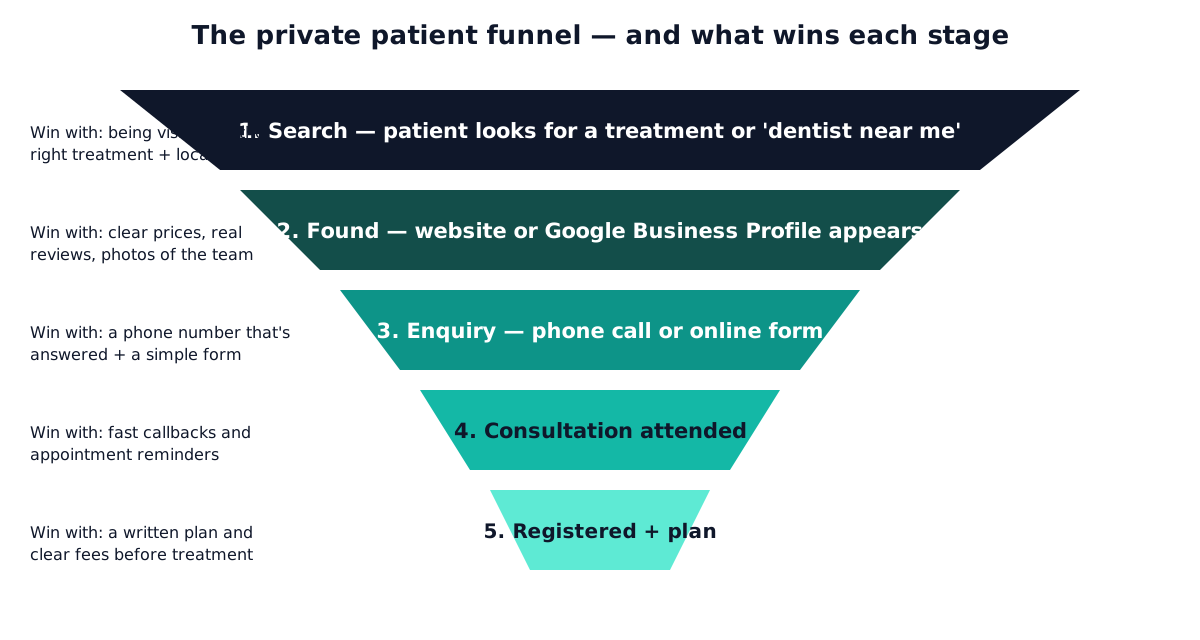
The minimum bar before switching ads on: a Google Business Profile with correct categories, current photos and regular posts; reviews flowing and being replied to; treatment pages with prices; and a contact form plus a phone number answered during opening hours. Ads sent to a bare homepage or an unanswered phone simply buy you expensive missed calls. This is also the point to confirm that the website converts well on mobile — if treatment pages are slow or forms are buried, fix those problems before paying for traffic.
How do you know which marketing channels bring useful enquiries?
Keep a simple weekly record of enquiries, booked consultations, attendances and accepted treatment plans. Define each stage with reception and count it consistently. A click on a phone number or booking button shows intent; it does not confirm that a call connected or an appointment was booked.
Record the acquisition channel where you have reliable evidence, and keep the landing page as a separate field. Someone who enquires from an implant page could have arrived through an advert, an organic result or a recommendation. The page they visited alone cannot identify the channel. Retain an unknown category rather than guessing.
For external campaigns you control, consistent source, medium and campaign tags can help identify visits in analytics. Follow Google’s campaign URL guidance and check how your existing advertising integration handles attribution. Keep patient names, contact details and clinical information out of campaign URLs and analytics events; Google’s guidance on avoiding personally identifiable information explains the URL and form-data risks. Keep clinical records in the practice’s appropriate systems.
Use the record to decide what to investigate next:
| Observed pattern | Check before increasing spend |
|---|---|
| Relevant visits but few enquiries | Treatment information, fees, mobile contact options and whether measurement is working |
| Enquiries but few bookings | Response times, appointment availability, suitability and how fees are explained |
| Bookings but few attendances | Confirmation and reminder processes, accessibility and recorded cancellation reasons |
| Useful enquiries from an unknown source | Missing campaign information and how reception records referrals |
These are investigation prompts, not proof of a cause. Review costs alongside the actual outcomes, allow time for enquiries to progress, and avoid choosing a winner from a handful of bookings. The dental Google Ads guide explains how primary and secondary conversions should support that review.
What does a sensible 90-day patient acquisition plan look like?
This illustrative first-quarter sequence is not a delivery promise or a forecast of enquiries. Adjust it to capacity, access, budget and the starting position:
| Weeks | Focus | What to review |
|---|---|---|
| 1–2 | Fix the foundations: Google Business Profile, treatment pages with fees, enquiry handling script, click-to-call and short forms | Check that pages and enquiries work correctly |
| 3–4 | Launch neutral review requests for eligible genuine patients | Check invitations and voluntary responses without targeting a rating |
| 5–8 | Launch Google Search Ads on 2–3 high-value treatments, tight local radius | Review paid enquiries and search terms where data is available |
| 9–12 | Start local SEO and content; formalise referral scheme and patient recall | Review organic impressions and cost per enquiry; improvement is not guaranteed |
Use the 90-day review to assess costs and enquiry handling. If volumes are low, state that uncertainty rather than treating a few conversions as a stable benchmark. From there it becomes an optimisation exercise, not a gamble. Cogrank runs this as a structured monthly engagement — how the process works is documented openly, including what is and is not included at each tier on the services page.
Next step
Request a free dental marketing audit: a review of local visibility, website conversion and Google Ads where applicable. You receive a written summary of three to five priorities. We confirm scope and timing after your enquiry; a discussion is optional. There is no obligation to buy a service.
You can also compare Starter and Core.