Private dental clinics do not need more traffic. They need booked appointments for treatments that protect diary utilisation and treatment production — at a cost per patient they can defend.
This guide sets out the framework Cogrank applies to Google Ads for UK private dentistry: which treatments to bid on, how to structure the account, what the GDC and CAP rules allow, and which numbers matter before you scale spend.
Want this run for you? See how Cogrank manages Google Ads for dentists — you keep the account, no lock-in.
What should a private dental clinic track in Google Ads?
Track qualified enquiries, booked and attended consultations, accepted treatment plans and collected revenue where reliable attribution is available. Clicks and impressions remain useful diagnostic measures, but they are not patient outcomes.
Useful operating metrics:
- Cost per qualified enquiry (form, call, or WhatsApp with treatment intent)
- Cost per new private patient registration
- Share of enquiries by treatment (implants, Invisalign, composite bonding)
- Landing-page conversion rate by device
If an agency only reports clicks, ask for the enquiry and booking pipeline instead. See how Cogrank pairs paid search with technical SEO on the services and pricing page.
Which treatments are worth bidding on first?
Choose initial treatments using demand, practice capacity, margins and an affordable test budget. Implants, clear aligners and cosmetic work are possible priorities, not universal winners. The comparisons below are planning examples; general dentistry and emergency enquiries may be valuable for a practice equipped to serve them.
| Usually strong paid intent | Often weak or messy intent |
|---|---|
| Dental implants | Generic “dentist near me” alone |
| Invisalign / clear aligners | Unqualified emergency calls only |
| Composite bonding / smile makeovers | Pure NHS price shopping |
| Private hygiene (in some catchments) | Broad “cheap dentist” queries |
Use treatment-relevant keywords and review actual search terms before adding negatives. The examples below are not blanket exclusion lists: a person researching NHS options may also be considering private care.
| Treatment cluster | Example search terms | Example negatives |
|---|---|---|
| Implants | “dental implants cost [city]”, “private implant dentist near me” | “nhs”, “cheap”, “implants abroad” |
| Clear aligners | “invisalign cost uk”, “clear aligners private [city]” | “nhs”, “free”, “diy aligners” |
| Cosmetic | “composite bonding near me”, “teeth bonding cost” | “nhs”, “home whitening kit” |
The exact mix depends on postcode competition and chair capacity. A clinic with spare implant capacity should not run the same account structure as one full on hygiene and short on restorative time.
How much does Google Ads cost for a private dental clinic?
Plan on £3,000–£12,000 per month in Google ad spend, billed by Google directly and separate from any management fee. Industry benchmarks put the average dental cost per click around $7.85, implant terms at $12–$25 (and up to $50 in dense cities), and cost per lead between $63 and $116 (dental Google Ads benchmarks, 2026; cost-per-click data). Benchmarks are dominated by US data, so treat them as planning ranges: UK private dentistry varies by postcode, and your own enquiry data should always override them.
The spend band is not a universal minimum or a guarantee of enough conversion data. Agree a test budget based on catchment, treatment capacity and plausible click costs, then review actual enquiry quality before increasing spend. Before raising budget, pressure-test the whole funnel: getting more private dental patients covers the owned channels — Business Profile, reviews and website conversion — that influence how many of those clicks become registrations.
For month-to-month engagement without lock-in, read the how it works process. Engagements are monthly with 30 days’ written notice, and the Google Ads account stays in the clinic’s name.
How should a dental Google Ads account be structured?
Separate treatment campaigns when budgets, locations and reporting needs justify them. If conversion volumes are limited, a simpler structure may be more useful than splitting every treatment into its own campaign. The diagram below is an example, not a mandatory structure.
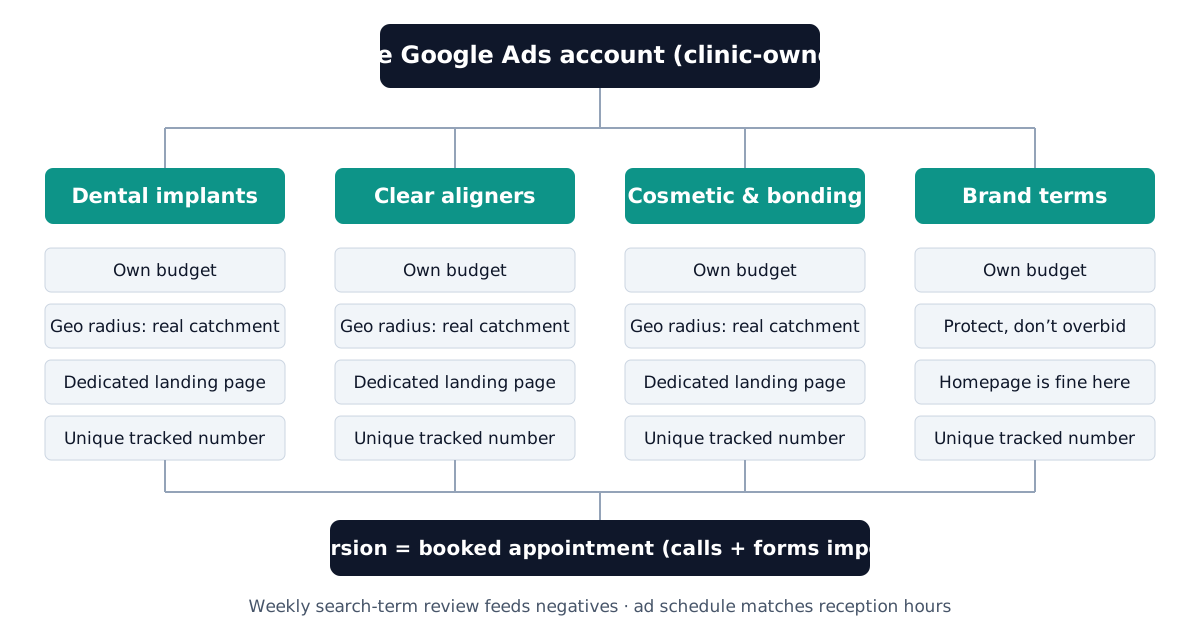
Within each campaign:
- Geo radius matched to the real catchment, not the whole city region
- Ad schedule matched to reception hours, so calls land on a human
- Search-term review weekly, moving irrelevant queries into negatives
- Primary and secondary conversions: use reliable business outcomes to guide bidding; keep supporting actions separate and avoid counting the same outcome twice.
It is the same architecture Cogrank applies across regulated, high-CPA verticals including healthcare — environments where a mis-aimed click costs real money and compliance constrains the copy.
What does a dental Google Ads landing page need?
Send visitors to the page that best answers the search intent. A dedicated treatment page is often useful, but a homepage is not automatically unsuitable. Test clarity and enquiry quality rather than imposing one layout on every practice.
- Message match: the H1 repeats the ad’s promise (“Private dental implants in Bristol”, not “Welcome to our practice”)
- Price indication: clear, representative fees or a “from £” price with its conditions where appropriate, so visitors can understand likely costs.
- Relevant clinical trust near the form: clinician identity and qualifications, GDC registration, clear treatment information and genuine patient evidence used with permission. Agency credentials are not clinical accreditation.
- A short, relevant form: request only what reception needs to respond; offer an accessible phone alternative.
- Speed and stability: aim for a mobile Largest Contentful Paint of 2.5 seconds or less and reserve image space. This is a performance target, not a promise about ranking or conversion.
- Clear navigation: prioritise the next step while keeping important practice, treatment and trust information accessible.
What do the GDC and CAP rules require of dental advertising?
Dental ads must not mislead, must not disparage other dentists, must not guarantee outcomes, and every claim or testimonial must be verifiable. The GDC’s guidance on advertising and the CAP Code (the UK advertising rules) apply to every paid search ad a clinic runs.
In practice that means:
- No superiority claims (“the best implants in London”) without substantiation
- Protected titles used correctly — only GDC-registered professionals may be called dentists
- “Was £X, now £Y” price claims backed by evidence
- Testimonials that are genuine, verifiable, and typical
Use verifiable facts, clear pricing and realistic expectations. Compliance is required regardless of whether a particular message improves conversion; evaluate enquiry quality with the practice’s own data.
Why do dental Google Ads campaigns fail?
Usually one of five failure modes:
- Structure that does not match the goal — budgets and reporting that obscure which treatments produce useful enquiries. Understanding how to get more private dental patients overall helps decide which treatments deserve dedicated campaigns and which belong in a broader acquisition strategy.
- Poor message match — a destination that does not clearly answer the search or explain the next step.
- No call tracking or form attribution — optimising to clicks while the phone rings unlogged.
- Bidding on NHS price language when the clinic only wants private high-value work.
- Agency lock-in and account ownership grey areas — the Google Ads account should always be in the clinic’s name.
A practical attribution sequence, with effort depending on the systems involved:
- Agree the call/form attribution required; choose tracking methods appropriate to the account.
- Log call outcomes (booked / not booked) in the practice system.
- Where technically feasible and appropriately permissioned, import reliable outcomes and test deduplication before using them for bidding.
Cogrank runs accounts you own, with exclusivity for agreed treatments in an agreed geographic area, both confirmed in writing before engagement. Monthly work has 30 days’ written notice.
What does a sensible first 90 days look like?
The following is an illustrative working sequence, not a guaranteed timetable. Access, tracking integrations and approval times can change it.
Days 1–14: account and conversion audit, treatment prioritisation, tracking fixes, campaign architecture.
Days 15–45: launch priority treatments, protect brand terms if needed, tighten geos and schedules to chair reality.
Days 46–90: cut waste search terms, improve ad copy around clinical differentiators, test landing messages, report cost per enquiry in plain English.
Results are not “#1 on Google in two weeks”. Paid search can produce enquiries within the first weeks once tracking is honest; compounding efficiency takes longer. Technical SEO, when added on Core, moves on a months-scale, not a weekend.
Next step
Request a free dental marketing audit: a review of local visibility, website conversion and Google Ads where applicable. You receive a written summary of three to five priorities. We confirm scope and timing after your enquiry; a discussion is optional. There is no obligation to buy a service.
You can also compare Starter and Core.